

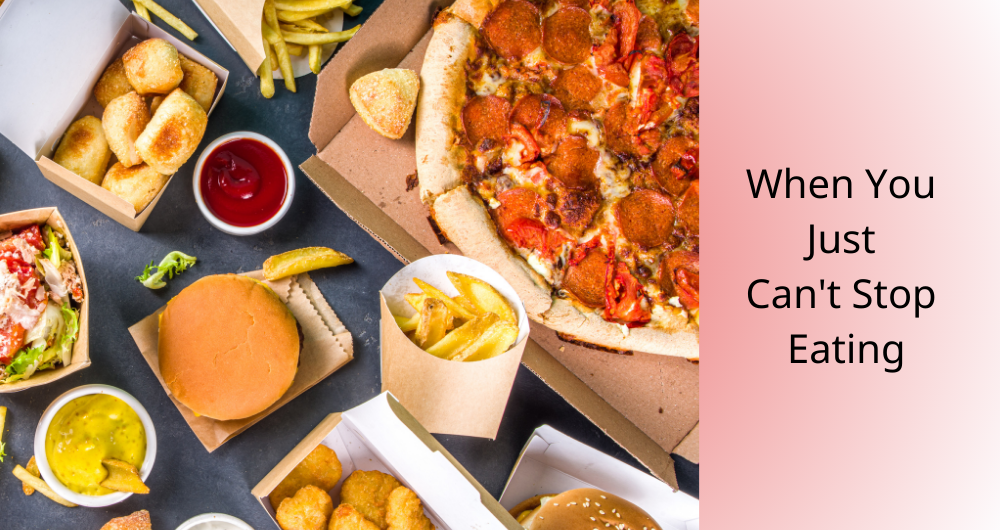
I’m sitting in my car in the Wendy’s drive-through line. Again.
It’s late. I just finished a long shift. I had told myself — really told myself — that this was it. No more fries. I know what they do to my body. I am literally a physician. I talk to patients about nutrition.
And yet I found myself there again and again. And I couldn’t stop.
If you’ve had your own version of that moment — whatever the food is, whatever the drive-through or the pantry or the freezer looks like — I want to talk to you about something that took me way too long to figure out.
Just trying not to eat will never be the answer
For years, I tried to handle my eating by cutting things out. That food is bad for me, so I just won’t eat it. Simple, right?
Except every time I did that, the same thing happened. I’d white-knuckle it for a while. The craving would get louder. Eventually I’d cave — and when I did, I’d eat way more of that food than I ever would have if I’d just let myself have some in the first place.
Then I’d feel awful. Try again. Cut it out harder. Cave harder.
Sound familiar?
Here’s the piece nobody teaches us: your desires around food are valid. And when you keep trying to override them, you’re fighting a losing battle.
What I Mean by “Desires”
When I say desires, I don’t just mean wanting a food. I mean the whole thing. The underlying reasons a food hits the spot for you.
For me and the french fries, it wasn’t really about fries. When I actually slowed down and looked at it, here’s what I was craving:
- Salty
- Crunchy
- Hot
- Convenient — handed to me through a window, zero effort
- A break after a hard day
- Spontaneous — the one thing in my day that wasn’t scheduled
When I saw that list, something clicked. I wasn’t addicted to Wendy’s. I was desperate for a small moment of spontaneity, a break, and some crunchy salty goodness. And I’d landed on fries as my one way to get all of that.
That’s a totally different problem to solve.
The Desire Deficit (And Why This Matters More Than You Think)
Here’s the bigger picture. Most of us — and especially women in demanding careers, especially moms, especially anyone playing three or four roles at once — live in what I think of as a desire deficit.
So much of our lives has nothing to do with what we actually want.
We get up when the alarm says so. We drive where other people need to go. We cook what the kids will eat. We say yes to the committee. We suppress what we actually want for most of the day — and then we wonder why we can’t stop eating at night.
If food is one of the only places you get to want something and actually have it? Of course your brain is going to latch onto that hard.
The answer isn’t to shut that down. The answer is to start taking your desires seriously — with food, and honestly, everywhere else too.
The Questions to Ask About the Food You Keep Going Back To
Here’s what I want you to try. Pick one food you keep ending up with — the one that’s been a pattern for you. Grab a piece of paper. And spend 30 seconds brainstorming:
- What are the flavors that draw me in? Salty? Sweet? Spicy?
- What are the textures? Crunchy? Creamy? Warm?
- Is it the convenience? The fact that it takes zero effort?
- Is there a memory attached to it — something from childhood, or a comfort association?
- Is it the spontaneity? The fact that it’s a little break from the scheduled day?
- Is it that it’s the first time you sat down and paused all day?
Write it all down. Don’t do it in your head — it’s slippery. Things get lost.
You’ll start to see that the food you keep going back to is carrying a lot of weight. Which means — good news — there are lots of other ways to meet those same needs.
Finding Alternatives That Aren’t Consolation Prizes
This is where most diets get it wrong. They hand you the “healthy version” and expect you to just accept it. And if it’s kind of sad? Tough. That’s the price of being good.
Hell no.
The food you eat to support your body needs to actually hit the spot. Not kind of. Really. If it feels like a consolation prize — the cheap version of the real thing — you will not stick with it. Nobody would.
Here’s what I actually did for the fries:
- I kept bags of salt and vinegar peanuts in my car. Crunchy, salty, shelf-stable, faster to grab than pulling into a drive-through. Turned out they were so satisfying I barely ate any.
- At restaurants, I’d order deep-fried Brussels sprouts instead of fries. Still salty, hot, crunchy, just as easy to order. Often I liked them better.
- For weekend breakfasts — I had told myself low carb meant no more waffle mornings. Then I found a fluffy low-carb waffle recipe I actually love. I make big batches, freeze them, throw them in the microwave on a work morning with berries and whipped cream. Done.
- When I want something rich and creamy, my husband makes low-carb crème brûlée in little mason jars in the sous vide. Egg yolks and cream and vanilla. Portioned, easy to grab, feels indulgent as hell.
None of these feel like I’m missing out. I’m excited to have any of them. That’s the test.
What Changes When You Do This
When you start eating this way — honouring your desires around food and really loving the food that works for your body — something shifts.
There’s no panic. No sense that everything’s about to be taken away from you. No white-knuckling.
Honestly? What I feel now when I decide to dial my eating back in is a little bit of excitement. Like — okay, let’s plan some really good food this week. Let’s cook something fun.
That’s the opposite of how most of us experience “getting back on track.”
And it’s the reason I’ve been able to keep my weight off for about 10 years now. Not because I’m more disciplined than anyone else. Because what I’m doing doesn’t require discipline. It requires me to actually listen to what I want and find ways to give it to myself.
Where to Start
If this is resonating, here’s my suggestion. Don’t try to overhaul everything.
Pick one food. The one that’s been a pattern. Grab paper. Spend 30 seconds on what actually attracts you about it.
Then start experimenting. One or two alternatives at a time. Give yourself permission for some of them not to work — that’s part of it. When you find one that truly hits, you’ll know. There’s no deprivation feeling. You’re just happy to eat it.
Those are the winners. Keep finding them.
Want to hear me walk through this in more detail? I go deeper on the exact questions, more examples, and the bigger picture of the desire deficit in Episode 351 of the Thriving As A Physician podcast — “Have Your Cake and Eat It Too.” Search it wherever you get your podcasts. Click below to listen.


Recent Comments